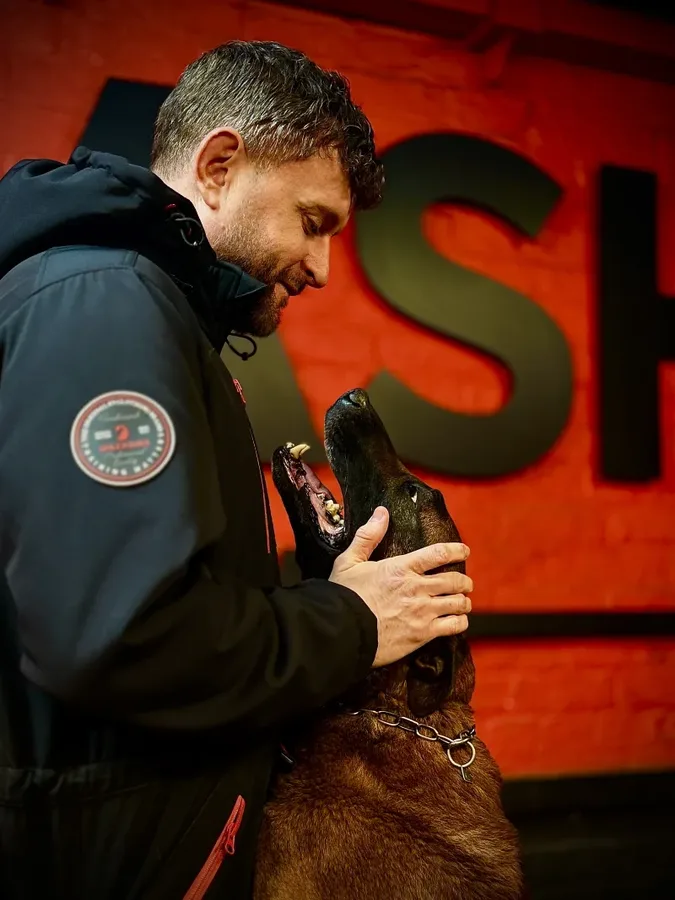

A big problem in modern dog training is how quickly people rush to judgement based on a single aspect of body language.
A dog carries itself with a low posture, low tail, ears back, cautious movement, and suddenly the internet behavioural experts appear in the comments claiming abuse, suppression or "shutdown behaviour".
But behaviour is far more complex than a few seconds of body language in a social media clip.
You Cannot Train Genetics Out of a Dog
The reality is this: you cannot train genetics out of a dog. And that is the part so many people either do not understand or choose to ignore.
You cannot train genetics out of a dog.
The vast majority of human-aggressive or reactive dogs that come to professional trainers are not dominant, evil, or "made aggressive" by training methods. They are deeply fearful animals. Their behaviour is rooted in insecurity, nerves, genetic sensitivity, and poor coping mechanisms.
Good training can absolutely help these dogs. We can reduce dangerous behaviour. We can neutralise reactions. We can teach better choices. We can improve impulse control. We can build confidence through structure and clarity. But what we cannot do is fundamentally change the dog's core character.
A genetically nervous dog will always be genetically nervous. That does not mean the dog cannot live a stable, safe and fulfilled life. It simply means the dog learns how to cope with the world around it more effectively. That distinction matters.
Character Is Not Evidence of Mistreatment
Take a naturally cautious dog like Heidi. Regardless of how she is trained, she carries herself with lower posture and softer body language because that is her temperament. If you watched her walk from her bed to her water bowl with absolutely no pressure around her whatsoever, she would still move the same way.
That is character, not evidence of mistreatment.
Yet people see one clip online and immediately start projecting their own narrative onto the dog. This is where selective perception and confirmation bias come into play. People often decide what they believe before they have objectively assessed what they are looking at. They ignore every positive indicator in front of them and fixate on the one thing that supports the conclusion they already wanted to reach.
What is even more telling is that in many of these videos, there may only be one naturally softer or more submissive dog present, while the rest of the dogs are moving confidently, engaging freely, displaying neutral or bold body language and showing no signs of distress whatsoever. But those dogs are ignored. The focus remains entirely on the one nervous dog because it fits the emotional narrative people want to push. That is not behavioural science. That is bias.
When Science Gets Replaced by Ideology
Another issue is the echo chamber effect within certain force-free circles online. Groups of people repeat the same emotionally driven rhetoric to each other without ever challenging their own understanding of canine behaviour, stress responses, genetics, or learning theory. Over time, the opinion becomes reinforced simply because everyone around them believes the same thing. Science gets replaced by ideology.
And this is often why you rarely see credible rehabilitation results demonstrated by these people. It is easier to criticise a short clip online than it is to work hands-on with dangerous, fearful, unstable dogs in the real world.
What Real Behavioural Work Looks Like
Real behavioural work is not about creating robots. It is not about changing personality. It is about teaching dogs how to navigate life safely despite the genetics and experiences they carry.
Because at the end of the day, regardless of how you choose to train a dog, you cannot change a dog's character.