If there is one thing that brings new puppy owners through my door, it is those needle-sharp teeth. You carry home this soft little bundle, and within a week your hands, sleeves and ankles look like you have lost a fight with a bramble bush. Sound familiar? You are not doing anything wrong, and your puppy is not broken.
Let me tell you straight, from years of working with real dogs and real families across St Helens and Merseyside, that knowing how to stop puppy biting is not about being soft and it is not about being harsh. It is about being clear. Get the clarity right and the biting fades fast. Get it wrong and you can drag it out for months.
Why Puppies Bite in the First Place
Before you fix any behaviour, you have to understand it. Puppies do not bite to be nasty or dominant. They bite because it is how they are built. A pup has no hands, so its mouth is how it explores the world, tests things and plays with everything it meets, including you.
There are a handful of reasons the teeth come out:
- Teething. Between roughly three and six months those baby teeth are dropping out and adult teeth are pushing through. Sore gums mean a pup wants to chew on everything in sight.
- Play and social learning. Puppies learn about bite pressure by mouthing their littermates. When they leave the litter, you become the littermate.
- Exploration. New textures, new objects, your fingers. The mouth is the tool it reaches for.
- Overtiredness. An overtired pup is like an overtired toddler. It gets wild, nippy and cannot settle.
- Breed and instinct. Collies, cattle dogs and other working breeds carry herding and prey drive. Moving feet and hands set them off more than most.
The Mistakes That Make It Worse
Here is where a lot of well-meaning owners go wrong, usually following advice they read online. Some of it is not just useless, it actively winds the pup up.
- Yelping loudly. For some pups it works. For plenty of others a high-pitched squeal sounds like a squeaky toy and cranks them right up.
- Snatching your hand away. Fast-moving hands trigger the chase and grab instinct. You become the game.
- Punishment. Smacking, pinning, or holding the mouth shut breaks trust and teaches your pup that hands are frightening.
You cannot punish a puppy out of doing something that is completely natural to it.
None of that gives the pup any information about what you actually want. It just adds noise, fear or excitement, and every one of those makes the biting worse.
How to Stop Puppy Biting the Right Way
Now the part you came for. The core of how to stop puppy biting is simple: make the wrong target boring and the right target brilliant. Your pup is going to chew and bite something, so your job is to point it at the right thing every single time.
Keep a toy or a chew within reach in every room. The second those teeth land on skin, calmly redirect onto the toy and make the toy come alive. Wiggle it, let the pup win it, praise like mad when it takes the toy instead of your hand. You are not stopping the urge, you are giving it a legal outlet.
Teach Bite Inhibition, Not Just No Biting
This is the bit people miss. Before you stop biting altogether, teach your pup to control the pressure of its mouth. This is bite inhibition, and it is one of the most important lessons a dog ever learns. A dog that learned as a pup to use a soft mouth is far safer for life, even in a moment of fright or pain.
When the pup mouths you gently, carry on. The moment the pressure gets too hard, let the fun stop. Over time the pup learns that soft mouths keep the good times going and hard mouths end them. You are teaching a dial, not just an on and off switch.
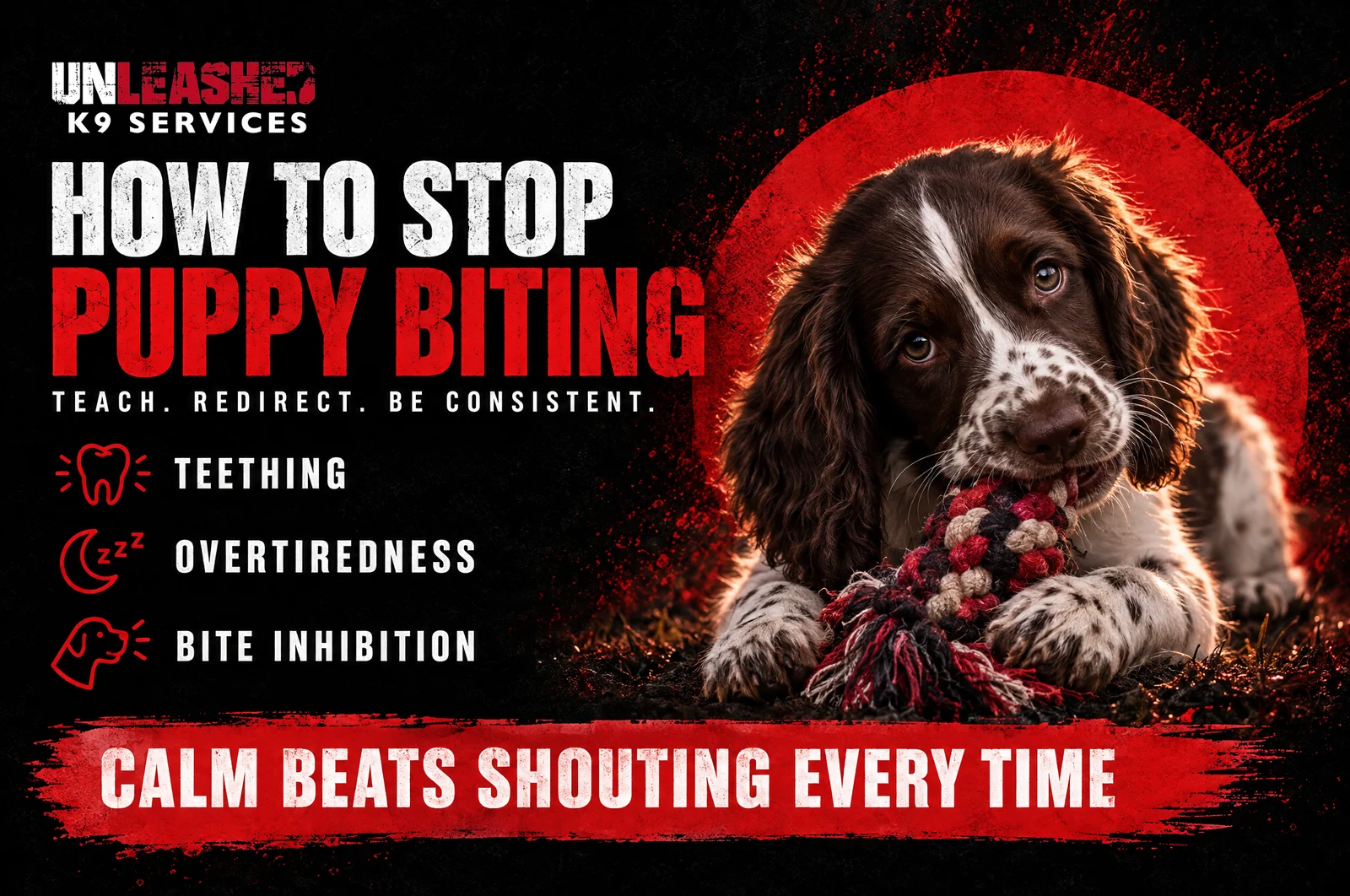
Calm Removal Beats Shouting Every Time
When redirection is not landing and the pup is still coming for you, the cleanest consequence is simply to remove the fun. No drama, no telling off. You stand up, fold your arms, and the game is over for ten or fifteen seconds. Or you step calmly over a baby gate and leave the room for a moment.
Teeth on skin, the game ends.
Soft mouth or toy, the game carries on.
Repeat it a hundred times.
Puppies are brilliant at working out what pays and what does not. Be boringly consistent and they join the dots quicker than you would believe.
When Overtiredness Is the Real Cause
This one catches nearly everybody out. A young puppy needs somewhere between eighteen and twenty hours of sleep a day. When people tell me their pup turns into a land shark every evening around six or seven, nine times out of ten it is not a training problem at all. It is an exhausted puppy that does not know how to switch off.
Before you drill any technique, look at the clock. If the biting spikes at the same times each day, build in proper nap times in a quiet crate or pen. A rested puppy bites a fraction of what a shattered one does.
Consistency, Needs and Getting Help
Whatever method you choose, the whole household has to sing from the same hymn sheet. If you calmly redirect but the kids scream and run, the pup gets mixed messages and progress stalls. Everyone follows the same simple rule and the pup learns twice as fast.
Make sure the pup's needs are met too. A puppy that is getting enough sleep, the right things to chew, gentle exercise and a bit of daily brain work has far less reason to use your hands as a chew toy. Biting is often just an outlet for a need that is not being met elsewhere.
Be realistic on timing. With consistent handling most pups improve noticeably within two to four weeks, and the worst of it is usually behind you by five or six months as the teething settles. But if the biting is hard, drawing blood, aimed at children, or paired with genuine growling and stiffness, do not sit on it. That is the moment for a professional pair of eyes. Our puppy training gets you and your pup on track early, and if you are unsure how serious it is, an initial assessment will tell you exactly where you stand.
Stick with it. Stay calm, stay clear, be consistent, and those needle teeth become a memory a lot sooner than you fear.