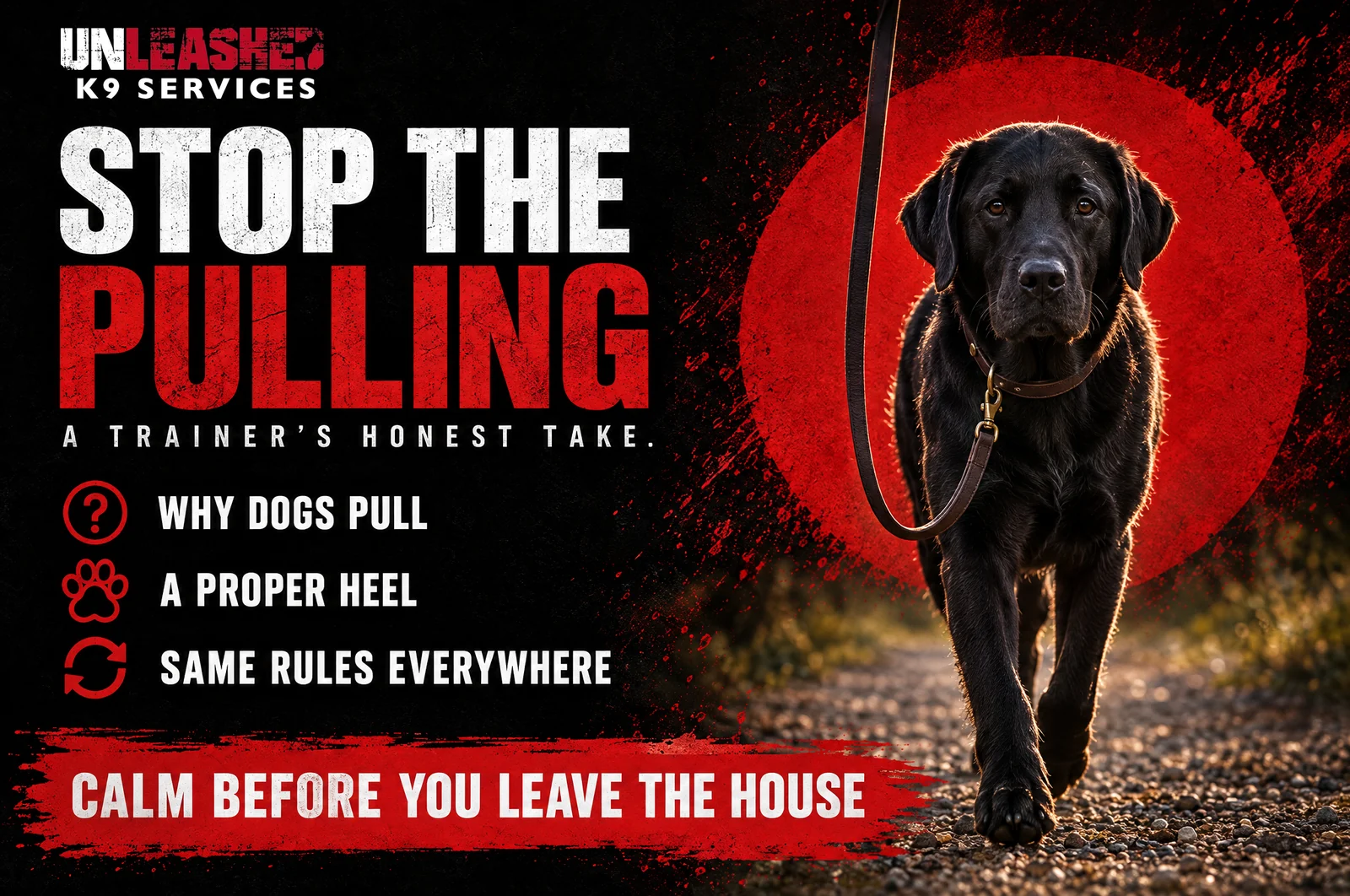
If you have ever been dragged down the street with your arm half out of its socket, you already know pulling is one of the most common problems I get called about. The good news is it is fixable. The honest news is that learning how to stop a dog pulling on the lead takes more than a gadget and a handful of treats. It takes the dog understanding that a loose lead is what moves them forward.
I have trained a lot of committed pullers over the years, from soft family Labradors to switched-on working breeds. The dogs that crack it are not the ones with the fanciest kit. They are the ones whose owners get consistent and give the dog clear information about what actually works.
Why Your Dog Pulls in the First Place
Pulling is not your dog being naughty or dominant. It is far simpler than that.
First, there is opposition reflex. When a dog feels pressure on the lead, its instinct is to lean and pull against it. Push a dog and it pushes back. That is wired in, not a decision.
Second, the world at the end of the lead is more interesting than you are. Lamp posts, other dogs, smells, the park. To your dog, forward is the reward, and pulling is what gets them there faster.
Add years of practice and a good dose of arousal, and you have a deeply rehearsed habit. A dog that has pulled every day for three years has had thousands of reps at it.
To your dog, forward is the reward. Every pull that gets them there has just been paid.
You Have Probably Reinforced It by Accident
Here is the part most owners do not want to hear. Every time your dog pulls and you take a step, you have paid them for pulling.
It is honest cause and effect. Dog pulls, dog gets closer to the thing it wants, pulling works. Do that a few hundred times and you have built a strong, reliable behaviour.
None of that makes you a bad owner. It just means we have to flip the equation so tension stops working and a loose lead starts paying instead.
The Popular Advice, and Where It Falls Short
You will have read the usual tips. Some have their place. None of them, on their own, reliably fix a committed puller.
- Stop dead and stand still. It can help a soft dog, but with a strong, aroused dog you often just become a post they lean on while they scan the environment. Stopping tells the dog what does not work. It rarely teaches them what does.
- Lure everywhere with treats. Food is a brilliant reward, but waving a treat at the dog's nose to keep them in place is bribery, not training. The second the food goes, so does the behaviour.
- Buy a no-pull harness. A well-fitted harness is a decent management tool that saves your shoulder while you train. It is not a fix. Plenty of dogs learn to pull like a sled team in one.
Kit manages the pulling today. Training removes it for good.
How to Stop a Dog Pulling on the Lead for Good
The whole game is teaching one clear rule: a loose lead moves you forward, a tight lead does not.
Set off, and the moment the lead is slack and the dog is anywhere near where you want it, mark it and reward. The moment the lead goes tight, stop moving forward, change direction, reset, and start again. You are not nagging. You are giving the dog clean, repeatable information.
Reward the position you want, not just the absence of pulling. Pay heavily when the dog is beside your leg with a loose lead and checking in with you. That focus and engagement on you is the real target.
Loose lead, you move.
Tight lead, you stop.
Good position, you pay.
Every walk, no exceptions.
Why I Rate a Proper Heel
This is where I differ from the reward-only crowd. I want a dog that can hold a proper heel as a default, not just a dog that is not quite pulling.
A heel gives the dog a job. Instead of scanning for the next thing to react to, it has a clear place to be and a clear task: stay with me. A working dog with a job in its head has no spare capacity to wind itself up. That is why a solid heel calms reactive dogs, and dogs feel safe inside that structure.
Sort the Arousal Before You Leave the House
Half the pulling battle is won or lost before the front door opens. A dog that is already bouncing off the walls, whipped up by the lead and the word walkies, is in no state to think.
Slow the whole ritual down. Lead on calmly. If the dog is spinning, wait. Step outside only when the dog is settled. A calm start makes a dog far easier to keep on a loose lead.
Everyone Follows the Same Rules, Everywhere
Consistency is where most training quietly dies. If you hold the standard but your partner lets the dog drag them to the park every morning, the dog simply learns that pulling works sometimes. Sometimes is enough to keep a habit alive.
Everyone who walks the dog follows the same rules. Then you proof it. A loose lead in your quiet street is a start, not the finish. You need it around other dogs, near the park gates, past the school run. Raise the distraction slowly across new places, and that is how you truly stop your dog pulling on the lead in the real world, not just on the landing at home.
Be Realistic About the Timeline
Let me be straight with you. A habit built over years does not vanish in a weekend.
Your dog is not being difficult. They are unlearning something they have practised thousands of times, and that takes honest, consistent repetition. Some dogs come round in a fortnight. A hardened puller can take a couple of months of daily effort. If you want it done properly and quicker, structured lead walking sessions or hands-on 1-2-1 training will get you there faster than muddling through alone.
Stick to the rules, pay the position you want, and stay consistent. The dog on the other end of that lead is more than capable. Give it clear information and it will meet you there.