Ask ten dog owners about crates and you will get ten different opinions, half of them wrong. I have trained hundreds of dogs across Merseyside, and I can tell you plainly: a crate, used properly, is one of the kindest, most useful tools you can give a young dog. It is not a cage. It is a den.
This guide walks you through crate training a puppy the way I do it with clients: calm, structured and built on good associations. Get it right and you end up with a puppy who takes himself off to bed, toilets on cue and settles without a fuss.
Why a Crate Actually Helps Your Puppy
Dogs are den animals. In the wild a young dog seeks out a small, enclosed, defensible space to rest. A crate gives your puppy exactly that: somewhere that is his, where nothing bad happens and he can switch off.
Beyond the security, a crate earns its keep in practical ways.
- It speeds up toilet training, because a puppy will rarely soil where he sleeps.
- It stops destructive rehearsal, so no chewed skirting boards or swallowed socks while your back is turned.
- It keeps him safe in the car, where a loose puppy is a genuine hazard.
- It gives him a place to settle when the house is busy, the doorbell goes or the kids have friends round.
Is a Crate Cruel? Let Me Settle This
This is the objection I hear most, usually from someone picturing a dog locked in a tiny box all day. That is not crate training. That is neglect, and no trainer worth listening to would defend it.
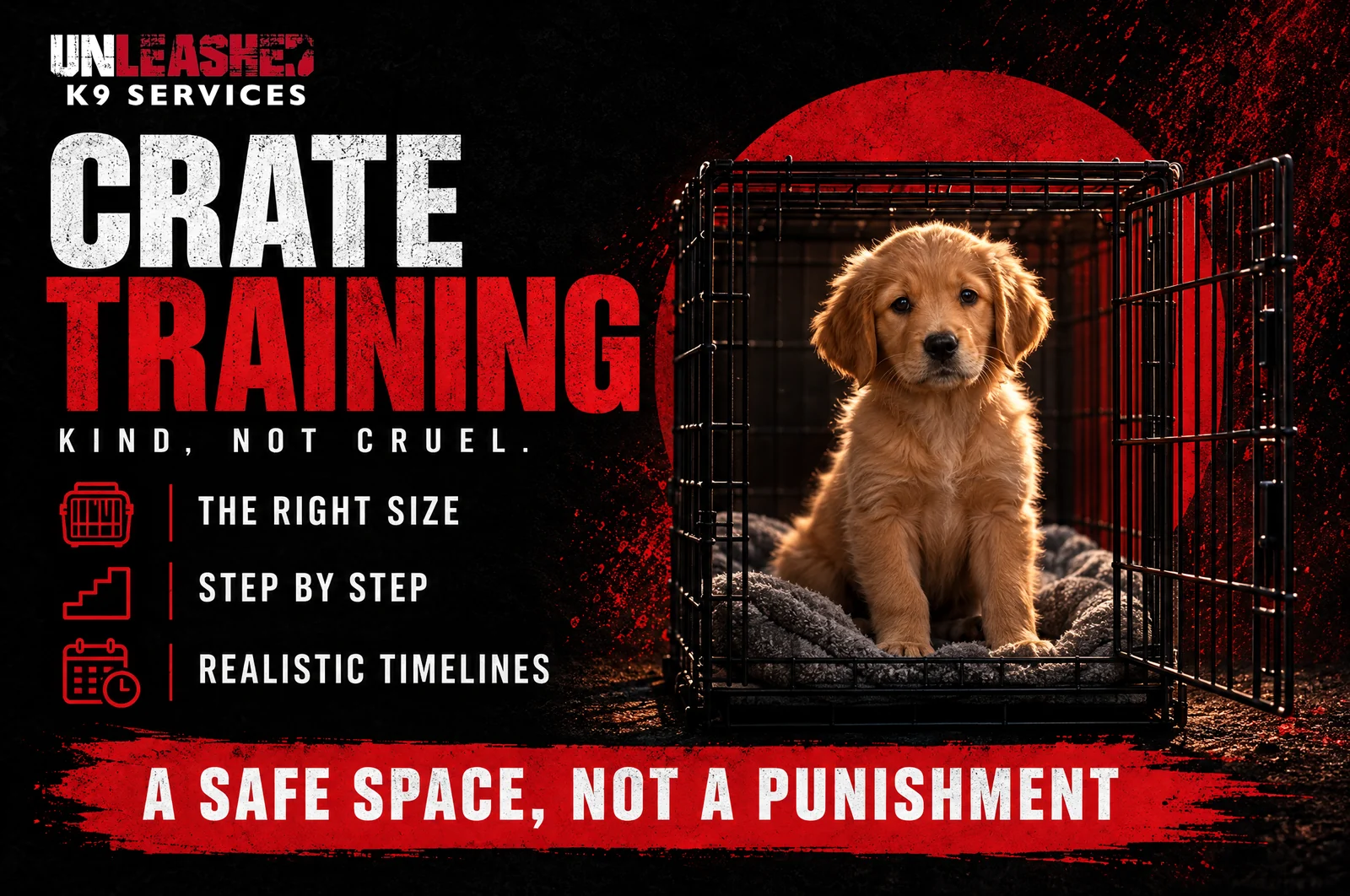
Done properly, the crate is never a prison and never a punishment. It is a bedroom your puppy chooses to use. It all hinges on association. If every trip into the crate comes with food, calm and good things, your puppy learns to love it. If you shove him in there when you are cross, he learns to fear it. Same box, completely different outcome.
A crate is only cruel if you use it cruelly. The tool is not the problem, the handling is.
The other half of the rule is time. A crate is a resting place, not a storage cupboard. A puppy has a small bladder and a big need for company, so you never leave him shut in for hours on end. Respect that and the cruelty argument falls apart.
Choosing the Right Size and Setting It Up
Size matters more than people think. The crate should be just big enough for your puppy to stand up, turn around and lie down flat. That is it. Too big and he will happily toilet in one corner and sleep in the other, which quietly wrecks your toilet training.
Buy a crate sized for the adult dog, then use a divider to shrink the usable space while he is small and open it up as he grows. Line it with a comfy bed, add a safe chew, and put it somewhere in the middle of family life rather than a cold, isolated room. A cover or a blanket over the top makes it darker and more den-like, which most puppies love.
Crate Training a Puppy Step by Step
Here is the method I give every client. Do not rush it. A few unhurried days now save you weeks of hassle later.
Introduce it open.
Feed him inside.
Close the door for seconds, then minutes.
Build from there.
Start with the door wide open and toss a few treats inside so going in is always the puppy's own idea. Feed his meals in there with the door open until he strolls in without a second thought. Once he is comfortable, close the door for a few seconds while he eats, then open it before he finishes. Slowly stretch that closed-door time, sitting nearby at first, then moving away.
The golden rule: never let him out while he is crying or scratching. If you open the door the moment he protests, you have just taught him that noise works. Wait for a pause, even a short one, then let him out calmly. Reward the quiet, never the racket.
Overnight and Daytime Management
For the first few nights, put the crate in your bedroom. Your puppy has just left his littermates, and being able to hear and smell you keeps the panic down. When he stirs in the night, take him out for a quiet toilet trip, then straight back to bed with no play and no fuss. Once he is sleeping through, you can drift the crate to its permanent spot over a few nights.
In the day, use the crate for naps and short, sensible stretches, not as a way to park the puppy for a full working day. A young pup needs a toilet break roughly every couple of hours while he is awake. If your day cannot allow that, arrange a dog walker or a helper rather than stretching the crate time to breaking point.
Realistic Timelines and What to Expect by Age
Be honest about your puppy's age. As a rough guide, a puppy can hold his bladder for about one hour per month of age, plus one. So a two month old pup manages around three hours at a push, and that is a ceiling not to break, not a target to aim for.
Most puppies are settled in a crate within one to three weeks. Some take to it in days. A few, especially rescues or pups with a rough start, need longer and a gentler pace. None of that means it is failing. It means you keep the sessions short, positive and consistent.
Common Mistakes I See All the Time
Most crate problems are handler problems, and they are easy to sidestep once you know them.
- Buying a crate that is far too big, so it doubles as a toilet.
- Using it as a telling-off spot, which poisons the whole thing.
- Going too far too soon and leaving the puppy shut in before he is ready.
- Caving in to the crying at the wrong moment, teaching him that a tantrum opens the door.
Steer clear of those four and you are most of the way there. Crate training a puppy is not complicated, but it does reward patience and consistency. If you would like a hand building a calm, confident routine, our puppy training programmes cover crate work alongside everything else, and a proper initial assessment lets us tailor it to your dog.