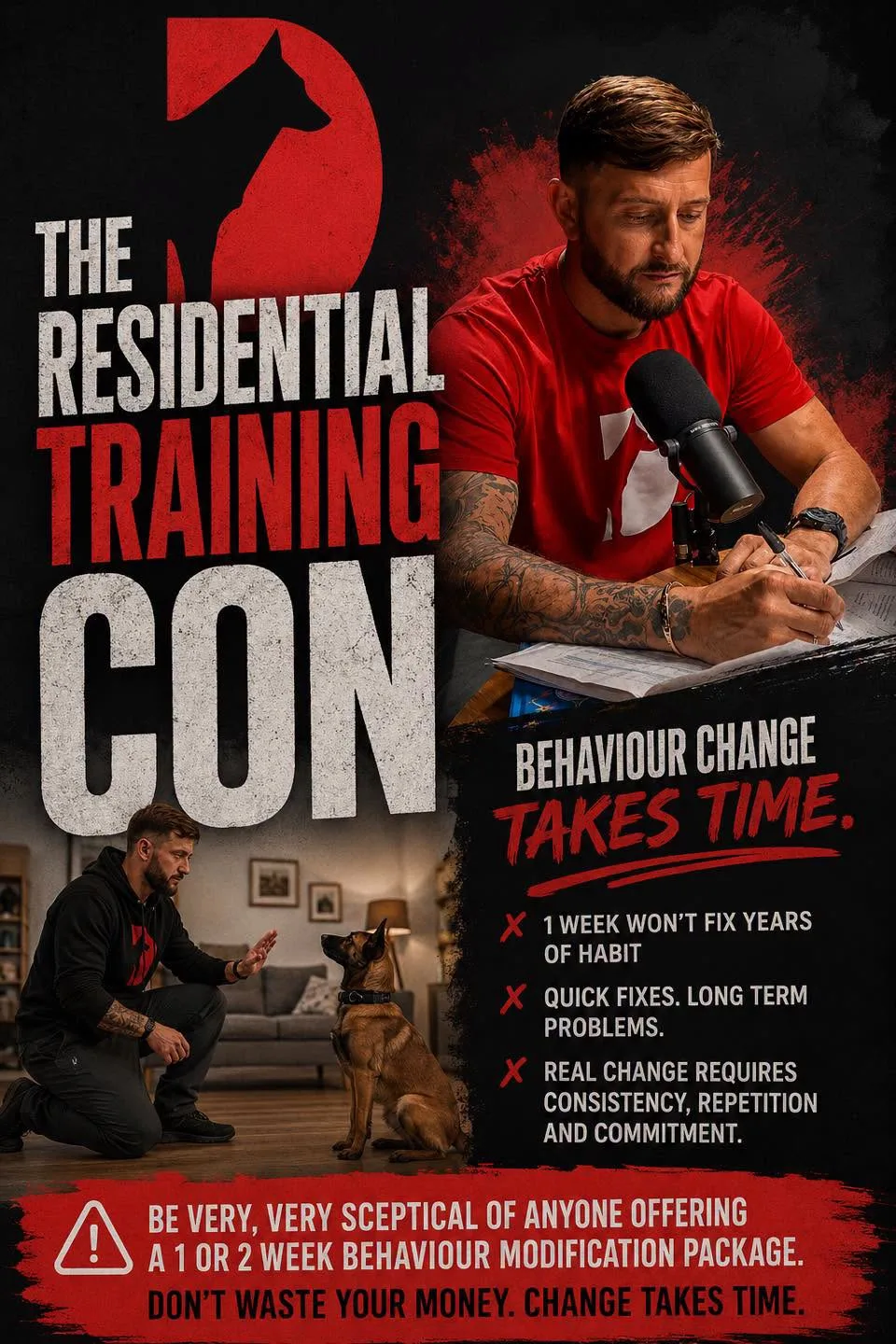
One of the biggest misconceptions in the dog training industry is the idea that a dog's behaviour can be "fixed" in one or two weeks through a residential training package.
I see these advertisements all the time. More often than not they're promoted by trainers who are relatively new to the industry, although some experienced trainers are guilty of it too. The difference is that experienced professionals should know better.
Residential Training Has Its Place
Let's start with the purpose of residential training.
Residential training absolutely has its place. Sometimes owners simply want someone to teach their dog obedience skills, improve manners, or put foundations in place. There is nothing wrong with that.
However, when we're talking about behaviour modification rather than obedience training, the conversation changes completely.
The purpose of a residential behaviour programme is not to "fix" a dog. It is to create an environment where new habits can be established and old habits can begin to lose value. That process takes time.
Behaviour Change Is Not Linear
Behaviour change is not linear. Anyone with even a basic understanding of behavioural science knows that relapse is a normal and expected part of the process.
When owners work with a trainer at home, they are learning a new skill set while trying to change their dog's behaviour at the same time. Mistakes happen. Timing is off. Consistency drops. The dog relapses into old habits and progress stalls. Sometimes those setbacks can put owners back weeks or even months.
A residential setting offers a significant advantage because those relapses are managed by professionals. They can recognise problems early, adjust the training plan and continue moving forward without losing momentum.
But none of that changes one simple fact:
One or two weeks is not enough.
Why the Quick Fix Cannot Work
Quite frankly, anyone selling one or two-week residential behaviour packages is selling a solution that has very little chance of producing meaningful, lasting change.
That's not necessarily because they're intentionally misleading people. Some genuinely believe they can achieve it. Others simply don't understand behaviour well enough. Either way, the outcome is often the same.
Behaviour change requires repetition.
It requires consistency.
It requires generalisation.
A dog doesn't truly understand a new behaviour because it performed it successfully a few times in a controlled environment. Real learning happens when that behaviour is repeated across different situations, different environments, different distractions and different levels of difficulty.
That takes time.
Months, Not Days
A proper residential behaviour programme should generally be measured in months, not days. Four, six, eight or even twelve weeks is often far more realistic depending on the severity and history of the behaviour.
And even then, the work is not finished.
A Foundation, Not a Fix
One of the biggest myths in dog training is that a residential programme "fixes" the dog.
It doesn't. What it does is provide a strong foundation.
The trainer's role is to build new habits, create structure, improve decision-making and reduce the reinforcement history of unwanted behaviours. The owner's role is then to continue that work consistently once the dog returns home.
Without that commitment, even excellent residential training can quickly unravel. The reality is that residential training means very little if the handler and everyone else in the household are not prepared to maintain the same standards.
Of course, there are exceptions. Sometimes a dog will spend four or six weeks in training and the results appear to last indefinitely. But more often than not, the real success comes later. It comes when the dog has been exposed to dozens of different situations, challenged by real-life distractions and repeatedly discovered that the same rules apply wherever it goes.
That is where lasting behaviour change happens.
Think About Human Habits
Think about human habits for a moment.
How many people have tried to stop smoking?
How many people have tried to stop biting their nails?
How many have succeeded on the first attempt?
Very few. Why? Because habits become deeply ingrained through repetition.
Now consider your dog's behaviour. The behaviour you're trying to change may have been rehearsed hundreds or even thousands of times. Every repetition strengthens the neural pathways behind it. Every successful outcome reinforces it further.
When you look at it through that lens, the idea that a week's training can erase years of practice becomes difficult to believe.
Who These Adverts Really Target
Yet this is exactly what many residential training adverts promise. They target owners who are exhausted, frustrated and desperate for a solution. People who are at the end of their tether are naturally drawn to quick fixes. The marketing is appealing because it offers hope.
But hope is not the same as reality.
In most cases, a one or two-week residential behaviour package is little more than an expensive interruption to the problem. The dog comes home looking better for a short period, but before long the same behaviours begin to reappear because the underlying learning was never properly established or generalised.
The owner is left with the same problems they started with and a much lighter bank balance.
Before You Hand Over Your Money
So if you're looking for help with serious behavioural issues, be very sceptical of anyone promising meaningful behaviour modification in one or two weeks.
Behaviour change takes time. It takes repetition. It takes consistency. And above all, it requires commitment from both ends of the lead.